Oct 4, 2026Microneedling OEM & Private Label
Is a Serum Validated for an E24 0.5 mm Micro-Infusion Device?
A U.S. buyer asked whether Formula C was validated for the E24 0.5 mm device. Learn the difference between recommended, compatible and validated.
A U.S. buyer recently asked us a very precise question about a private label micro-infusion project:
“Is Formula C specifically validated by your company for use with the E24 0.5 mm micro-infusion device?”
This is a more important question than simply asking whether a serum can be placed inside the applicator.
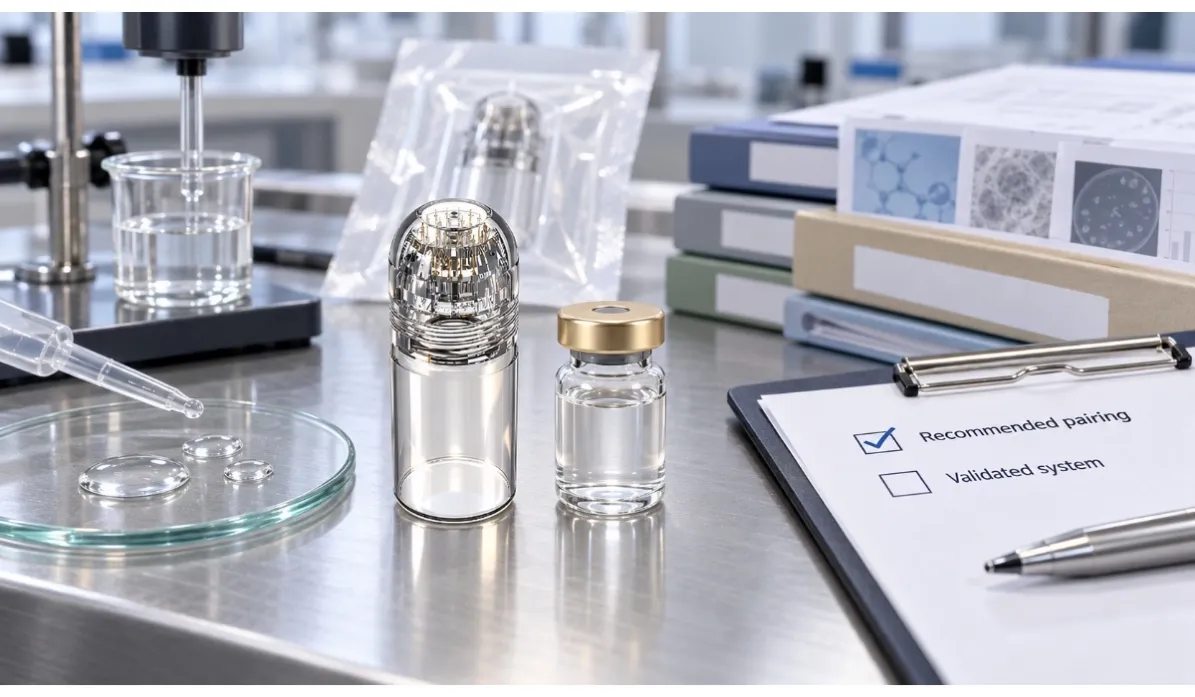
We recommend Formula C as one of the cosmetic formulas that can be evaluated with our micro-infusion devices. But a recommended pairing should not automatically be described as a clinically validated device-and-serum combination.
Those two statements require different levels of evidence.
What We Could Confirm About the Proposed Kit
The configuration being discussed with the buyer included:
- An E24 micro-infusion device
- A 0.5 mm needle specification
- One 5 mL serum vial
- One vial allocated to one treatment
- A cosmetic serum manufactured under controlled GMP conditions
- An individually packaged device processed through EO sterilization
We could also provide operating guidance for sample evaluation.
The face should be thoroughly cleansed and dried. The E24 should be held approximately 90 degrees to the treatment surface and pressed gently and evenly without excessive force.
Many existing projects use a treatment interval of approximately two weeks. However, the final consumer instructions, frequency and warnings must be confirmed according to the selected kit, target market, product positioning and responsible-party review.
These details describe the proposed product configuration and recommended evaluation method.
They do not, by themselves, prove that Formula C and the E24 0.5 mm device have completed a clinical validation study as one finished system.
“Recommended,” “Compatible” and “Validated” Are Not the Same
These words are often used interchangeably during product sourcing, but they answer different questions.
Recommended for evaluation
A supplier may recommend a formula because its composition, viscosity, packaging format and intended cosmetic positioning appear suitable for evaluation with the selected device.
This is the starting point for sampling.
It means the combination is considered a reasonable candidate—not that every safety, performance or marketing claim has already been proven.
Technically compatible
Technical compatibility generally concerns whether the formula and applicator can function together.
For example:
- Does the serum move through the dispensing structure?
- Is the liquid distributed consistently around the needle area?
- Does the formula create blockage?
- Does serum leak from the connection points?
- How much product remains inside the reservoir?
- Does the 5 mL volume fit the intended treatment routine?
- Are the ampoule, reservoir and formula compatible during storage?
These questions can be evaluated through controlled sample and packaging tests.
Our existing guide explains how viscosity, assembly and device angle can affect dispensing:
Validated for a defined purpose
“Validated” is a stronger statement.
Before using it, the supplier or brand should be able to explain:
- What was validated
- Which exact device model was used
- Which needle specification was tested
- Which serum formula and batch were evaluated
- Which operating procedure was followed
- Which users or subjects were included
- Which safety or performance outcomes were measured
- Which marketing claim the evidence is intended to support
A dispensing test may validate serum-flow performance under defined conditions.
A microbiological test may support the quality of a serum batch.
A stability study may support the formula’s shelf life in a specified container.
A controlled user or clinical study may be needed to support particular safety, tolerance or performance claims.
One type of evidence should not be presented as proof of every other claim.
An EO Report Does Not Validate the Serum
The buyer also asked for the EO sterilization report.
This is a reasonable request, but the report must be interpreted according to its actual scope.
For this project, the micro-infusion device is processed through EO sterilization and packaged separately. Batch-related sterilization documentation can be organized for the applicable product.
The Formula C ampoule is a cosmetic serum manufactured under controlled cosmetic GMP conditions. It should not be described as EO-sterilized simply because it is supplied in the same retail kit as an EO-processed device.
Similarly, an EO report for the device does not prove:
- Serum microbiological quality
- Preservative effectiveness
- Formula stability
- Device-and-serum compatibility
- Consumer tolerance
- Clinical efficacy
The device and serum require separate evidence, even when they are eventually sold together.
You can read more about this distinction here:
What Formula Documents Can Support
For a cosmetic serum project, the available review package may include:
- Complete INCI list
- Formula or product specification
- Certificate of Analysis for the applicable batch
- Microbiological test results
- Preservative or challenge-test information
- Stability or compatibility information
- Packaging specifications
- Recommended storage conditions
- Production and shelf-life information
These documents answer important questions about the formula.
However, they should not be summarized as “clinically validated with E24 0.5 mm” unless a study actually evaluated that exact combination under a defined protocol.
The U.S. FDA states that the responsible person for a cosmetic product must ensure and maintain records supporting adequate safety substantiation.
The FTC also expects objective product claims—especially claims concerning health, safety or measurable results—to have appropriate substantiation before they are used in marketing.
For this reason, the final evidence plan should follow the claims the brand intends to make.
What We Told the Buyer
Our answer was deliberately limited:
Formula C is one of the cosmetic formulas we recommend for evaluation with our micro-infusion devices. We can prepare it with an E24 0.5 mm sample so the buyer can assess assembly, dispensing, handling and the proposed 5 mL single-treatment configuration.
We did not describe it as a clinically validated E24–Formula C system because that statement would require evidence relating to the exact formula, exact device configuration, defined operating protocol and intended product claims.
This does not mean that the combination cannot be developed.
It means the development stage must be described accurately.
A Better Question for Buyers to Ask
Instead of asking only:
“Is this serum validated for the device?”
Ask the supplier:
“Which aspects of the exact serum-and-device combination have been evaluated, under what conditions, and which documents support those conclusions?”
The answer should separate:
- Formula quality and safety documentation
- Device specifications and sterilization evidence
- Dispensing and packaging compatibility
- Combined-use evaluation
- Evidence supporting the final marketing claims
This gives the buyer a much clearer understanding of what has already been established and what still needs to be completed.
Build the Evidence Around the Final Product
A private label micro-infusion kit is not fully defined by selecting a popular serum and a 0.5 mm applicator.
The device model, formula, vial size, treatment quantity, operating instructions, packaging, claims and target market must be reviewed as one commercial project.
BegoSkin can support the early development stage by organizing the available device specifications, serum information, sterilization documents and samples for compatibility evaluation.
If a buyer requires additional combined-use, tolerance or claim-substantiation testing, the exact study scope should be confirmed after the final product and intended claims are defined.
Contact BegoSkin with your selected device, serum direction and target market to discuss the evidence available for your proposed kit.