Aug 27, 2026Microneedling OEM & Private Label
Why Does a Micro-Infusion Device Dispense Serum Unevenly?
A UK beauty client noticed inconsistent serum flow during sample testing. Here is how device angle, serum viscosity and assembly can affect dispensing.
A micro-infusion device sample may look simple to test: fill the bottle, attach the needle head and press the device.
However, the first test does not always produce a continuous or even serum flow.
Does this mean the device is defective?
Not necessarily.
During a recent sample evaluation, a UK beauty client told us that the serum was not dispensing as consistently as expected. After reviewing the operating method with our production team, we identified one important detail: the device was being held at an angle rather than vertically.
This real testing case shows why device position, formula viscosity and assembly should all be checked before a buyer approves—or rejects—a sample.
The Client’s Sample-Testing Question
The client had received a micro-infusion device and compatible serum samples for an early-stage private label project.
During testing, the client noticed that the liquid did not always continue flowing evenly around the needle area. From the client’s perspective, it was reasonable to question whether the internal dispensing structure was working correctly.
Instead of immediately replacing the sample, we asked the client to review how the device was being held.
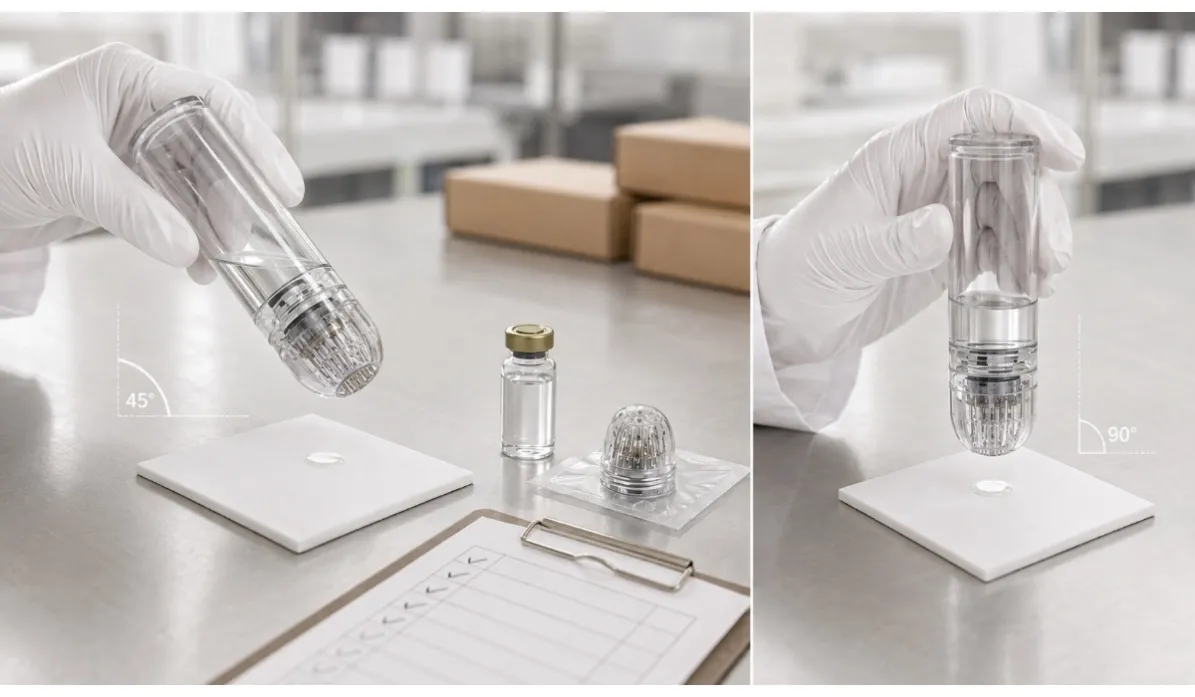
For this pump-style structure, the device should be kept approximately 90 degrees to the testing surface during dispensing. In other words, it should remain upright rather than tilted.
We then advised the client to repeat the test using the same device and serum while keeping the device vertical.
The final product evaluation is still in progress, so we will not claim that the project has already been approved. However, this case identified an operating detail that should be included in future sample instructions.
Why Does the Operating Angle Affect Serum Flow?
Inside a micro-infusion device, the serum must remain in contact with the liquid-delivery area.
When the device is held upright:
- Gravity keeps the serum closer to the dispensing path
- The internal pressing structure can work more consistently
- Liquid can move toward the needle area more evenly
- Less air may enter the dispensing path during operation
When the device is tilted, the serum can move to one side of the bottle. Depending on the remaining volume and formula viscosity, the liquid-delivery area may temporarily draw in air instead of serum.
The result may look like:
- Intermittent serum flow
- Uneven liquid around the needle area
- A delay before the serum begins to dispense
- Normal flow at one angle but slower flow at another
This is why a buyer should not judge the device from one quick test at an uncontrolled angle.
How to Test Serum Flow More Accurately
Before any controlled user evaluation, carry out the first dispensing test on a clean surface and follow the supplier’s instructions.
1. Confirm the assembly
Check that:
- The correct needle head has been fitted
- The thread is aligned properly
- The head is firmly connected
- No liquid is leaking around the bottle or connection
- Any protective components have been removed as instructed
Do not apply excessive force if the components do not connect smoothly. Incorrect threading can affect sealing and damage the sample.
2. Hold the device vertically
Keep the device approximately 90 degrees to the testing surface.
Avoid testing it horizontally or at a strong angle. Use the same position throughout the test so that the result can be compared consistently.
3. Allow the serum to reach the dispensing area
After filling or assembling the device, the liquid may not appear immediately.
Follow the recommended activation method and allow enough time for the formula to move through the dispensing path. Do not assume that pressing harder will necessarily improve the result.
4. Observe the flow over several presses
Record:
- How many presses are required before the liquid appears
- Whether the liquid is distributed evenly
- Whether the flow stops when the device is tilted
- Whether air bubbles are visible
- Whether serum leaks from a connection point
- How much liquid remains after testing
A short video is often more useful to the manufacturer than a message saying, “The serum does not come out.”
Serum Viscosity Also Matters
The same device may not dispense every formula in exactly the same way.
A lightweight serum generally moves through the delivery path more easily than a high-viscosity formula. A thicker formula may require more time to start flowing and may leave more residue inside the bottle.
During a microneedling serum compatibility test, buyers should evaluate the formula planned for the final retail kit—not only a convenient testing liquid.
Compare formulas separately and record:
- Time required to begin dispensing
- Distribution around the needle area
- Amount released during each press
- Residue inside the bottle
- Signs of blockage or interrupted flow
If the final serum formula changes after the device sample has been approved, the compatibility test should be repeated.
Other Reasons a Device May Not Dispense Correctly
If the device remains upright but the flow is still inconsistent, check for other possible causes:
- Incorrect assembly
- Loose or damaged connections
- Insufficient serum volume
- Air trapped in the dispensing path
- Serum viscosity outside the suitable range
- Residue blocking the liquid outlet
- A damaged sample component
Change only one testing condition at a time. If the angle, formula and needle head are all changed together, it becomes difficult to identify the actual cause.
What We Learned from This Client Case
This sample test reminded us that a supplier should not only send the product. The buyer also needs clear instructions explaining how to evaluate it.
For future sample projects, useful support should include:
- An assembly video
- The recommended dispensing angle
- The suggested serum volume
- Compatible formula guidance
- A simple sample-testing checklist
- A clear way to record photos and videos
Small operating details can determine whether a buyer sees a functional product or assumes that the sample has failed.
Evaluating a Micro-Infusion Device for Your Brand?
BegoSkin supplies private label micro-infusion devices, replacement needle heads, compatible serum ampoules and customized kit packaging.
When preparing samples, tell us which serum formula you plan to use and what configuration you want to test. We can help organize the device-and-serum testing points before you evaluate the complete kit.