Oct 5, 2026Microneedling OEM & Private Label
Does a 5 mL Serum Vial Equal One Micro-Infusion Treatment?
A 5 mL serum vial does not automatically equal one micro-infusion treatment. Learn how brands should verify dosage, residual volume and labeling.
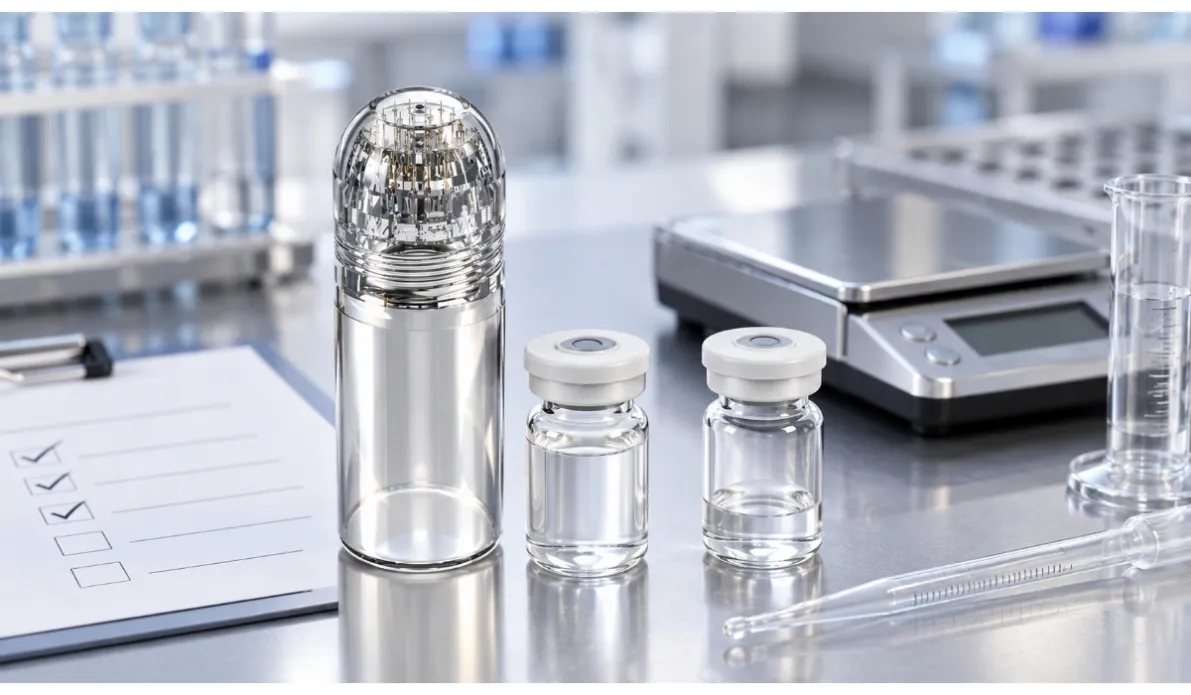
A U.S. private label buyer recently asked us a very specific question about a proposed E24 micro-infusion kit:
Can Formula C be supplied in a 5 mL vial as a single-treatment serum?
It sounds like a simple packaging question.
However, the volume printed on a serum bottle does not automatically establish how many applications it provides.
Before describing a 5 mL vial as a “single-treatment” product, a brand should confirm how the exact formula performs with the selected device, how much serum remains after use and what instructions will be provided to the customer.
The Short Answer
A 5 mL net content declaration tells the customer how much serum is inside the container.
It does not, by itself, prove that:
- The entire 5 mL is needed for one routine
- The device will dispense all 5 mL
- Every customer will use the same amount
- The remaining serum can be stored after opening
- The vial is single-use
- The serum is sterile
These are separate product and labeling questions.
For the U.S. buyer’s project, the proposed combination was Formula C, a 5 mL vial and an E24 0.5 mm device. We could recommend testing this configuration, but we should not define it as one treatment based only on the vial capacity.
Net Content and Usage Quantity Are Different
The serum label may accurately state:
Net 5 mL
This is a quantity declaration.
A statement such as:
One vial per treatment
is a usage instruction or product claim. It should reflect the intended routine and actual product performance.
For a cosmetic home-use project, the brand may also decide that “one vial per routine” or “one vial per application” is more consistent with its intended positioning than medical-sounding treatment language.
The final wording should remain consistent across the:
- Serum bottle
- Retail box
- Instructions for use
- Product page
- Training material
- Advertising
If the box says “one application” but the instructions tell the user to keep the opened vial for several uses, the product configuration is no longer clear.
What Determines the Actual Serum Quantity?
Several variables affect how much serum is used with a micro-infusion device.
1. Intended application area
A facial routine may use a different quantity from a face-and-neck or scalp routine.
A brand should not apply the same single-treatment statement to every application area without testing the relevant protocol.
2. Device construction
The amount transferred from the serum container depends partly on the device design.
Relevant factors may include:
- Reservoir capacity
- Dispensing structure
- Serum retained inside the device
- Liquid remaining around the connection
- Flow through or around the treatment head
- Amount required to initiate dispensing
The bottle may begin with 5 mL, but not all 5 mL will necessarily reach the application surface.
3. Formula viscosity
A lightweight formula and a more viscous formula may behave differently inside the same device.
Viscosity can affect:
- Dispensing speed
- Flow consistency
- Start-up time
- Residual serum
- Risk of slow flow or blockage
This is why the exact production formula—not water or a substitute serum—should be used during the final evaluation.
Our guide on micro-infusion device and serum flow testing explains why device compatibility must be checked with the planned formula.
4. User technique
The quantity used may also change according to:
- Number of passes
- Pressing or stamping frequency
- Application time
- Pressure applied
- Treatment area
- Whether the user stops when the routine is complete or when the vial is empty
A single demonstration video cannot establish the normal quantity for every user. Several controlled evaluations provide a more useful range.
“Single Treatment,” “Single Use” and “Sterile” Are Not the Same
These terms should not be used interchangeably.
Single treatment describes how many routines the supplied quantity is intended to support.
Single use normally indicates that the opened product or component should be used once and then discarded.
Sterile is a separate condition that requires supporting evidence applying to the exact product and packaging.
A sealed 5 mL vial is not automatically sterile. A sterile product is not automatically the correct quantity for one routine. A one-routine quantity is not automatically packaged in a way that prevents reuse.
Each statement needs its own basis.
This distinction is especially important when evaluating a cosmetic serum supplied with a microneedling or micro-infusion product. Our earlier article explains the difference between a cosmetic serum and a sterile microneedling solution.
How Should the 5 mL Configuration Be Evaluated?
For the U.S. buyer’s proposed Formula C and E24 configuration, we would recommend a controlled sample assessment using:
- The exact E24 model and treatment head
- The selected 0.5 mm configuration
- The final Formula C formulation
- The proposed 5 mL fill volume
- The intended facial application protocol
- The planned consumer instructions
During the evaluation, the brand and supplier should record:
- Starting fill volume
- Quantity needed to begin consistent dispensing
- Quantity used during the planned routine
- Serum remaining in the vial
- Serum retained inside the device
- Leakage or dispensing interruptions
- Differences between repeated evaluations
The objective is not to force the user to consume exactly 5 mL.
The objective is to determine whether 5 mL provides a practical amount for the intended routine without creating excessive shortage or unnecessary leftover product.
What If Serum Remains After the Routine?
A meaningful amount of serum remaining after use creates another packaging decision.
The brand needs to determine whether the customer should:
- Discard the remaining serum
- Keep the vial for another cosmetic application
- Transfer or store the product
- Use a smaller fill volume instead
That decision cannot be made from cost considerations alone.
It should take into account the container closure, preservation system, in-use stability, microbiological risk, storage instructions and the way the customer will handle the opened product.
The FDA notes that cosmetic contamination can be associated with raw materials, manufacturing conditions, ineffective preservation, packaging, storage and consumer use. Packaging therefore needs to support the intended handling of the formula.
If the remaining product is not intended to be stored, the instructions should say so clearly.
The Claim Affects the Entire Kit Configuration
Once a brand defines one vial as one routine, that decision affects more than the bottle label.
For example, a “four-routine starter kit” may require:
- Four serum vials
- Four individually packaged treatment heads
- Clear pairing instructions
- A suitable tray or insert
- Lot identification
- Storage and disposal instructions
- Refill packaging that follows the same configuration
If the device is reusable but the treatment head and serum vial are single-use, the instructions must clearly distinguish between these components.
This also affects repeat-order planning. A customer may need replacement heads and serum refills more frequently than replacement device bodies.
Brands planning their first retail configuration can also review what a first micro-infusion starter kit should include.
Do Not Let the Bottle Size Write the Instructions
A common mistake is to choose a convenient bottle size first and build the usage instructions around it afterward.
A better sequence is:
- Define the intended cosmetic routine.
- Select the exact device and formula.
- Test their dispensing performance together.
- Record the normal usage and residual range.
- Choose an appropriate fill volume.
- Finalize the bottle, box and instructions.
- Review every usage statement before printing.
For U.S. cosmetic products, net quantity information must accurately state the amount in the container. Labeling must also avoid false or misleading representations, and directions for safe use should be placed appropriately.
Our Answer to the Buyer
For this project, our answer would not simply be:
“Yes, 5 mL is one treatment.”
A more accurate response is:
“We can prepare Formula C in a 5 mL vial and evaluate it with the selected E24 0.5 mm device. Before describing the vial as one treatment, the final formula, dispensing performance, intended application area, residual quantity and instructions should be confirmed together.”
That answer may be less immediate than simply approving the buyer’s wording, but it reduces the risk of printing instructions that do not match the finished product.
Developing a Private Label Micro-Infusion Kit?
BegoSkin supports private label development of micro-infusion devices, compatible cosmetic serums, replacement treatment heads and customized retail packaging.
For a device-and-serum project, send us:
- Selected device model
- Intended cosmetic use
- Target market
- Preferred serum
- Proposed vial volume
- Number of planned routines
- Packaging concept
We can then organize an appropriate sample configuration for dispensing and packaging evaluation.