Sep 16, 2026Microneedling OEM & Private Label
What Does ISO 13485 Actually Tell a Microneedling Buyer?
Learn what ISO 13485 tells microneedling buyers about a manufacturer’s quality system—and why it is not product approval or market authorization.
A U.S. buyer recently contacted us about sourcing a private label micro-infusion device.
Her document request included:
- Manufacturing certifications such as ISO or GMP
- Sterilization documentation
- Individually sealed packaging
- U.S. regulatory documents
- Quality-control and defective-product policies
These requests are often placed in one compliance checklist. However, they do not all prove the same thing.
One of the most frequently misunderstood documents is ISO 13485.
An ISO 13485 certificate can provide useful information about a manufacturer’s quality management system. It does not, by itself, prove that a particular microneedling product is FDA cleared, CE marked or legally ready for sale in every market.
What ISO 13485 Is
ISO 13485:2016 is an internationally recognized quality management system standard for organizations involved in medical devices and related services.
It establishes requirements for processes such as:
- Document and record control
- Supplier and purchasing controls
- Production management
- Product identification and traceability
- Risk-based quality processes
- Handling of nonconforming products
- Corrective and preventive action
- Complaint handling
- Process validation
- Monitoring and measurement
According to the International Organization for Standardization, ISO 13485 helps an organization demonstrate its ability to consistently provide medical devices and related services that meet applicable customer and regulatory requirements.
The important word is system.
The certificate concerns how the organization manages relevant quality processes. It is not normally a product approval certificate issued for every model manufactured inside the facility.
What a Valid Certificate Can Tell a Buyer
When a private label buyer receives an ISO 13485 certificate, it can help answer several initial supplier-assessment questions.
Is the correct company certified?
The legal company name on the certificate should match the manufacturer or organization presented by the supplier.
A trading company’s name, a related factory’s name and the actual production facility are not automatically interchangeable.
If different company names appear across the quotation, ISO certificate, test reports and packaging, the supplier should explain the relationship between them.
What activities are included in the scope?
The certificate scope is more important than the ISO logo.
A scope may cover manufacturing, assembly, packaging or another defined activity. It may also be limited to particular product categories.
Buyers should check whether the stated scope is relevant to the product and work being purchased.
For a private label micro-infusion project, ask whether the organization’s relevant activities—such as device production, assembly or packaging—fall within the certified scope.
Which location is covered?
The certificate should identify the certified organization and site.
If production takes place at a different address, ask whether that facility is included in the certificate or managed as an outsourced process under the quality system.
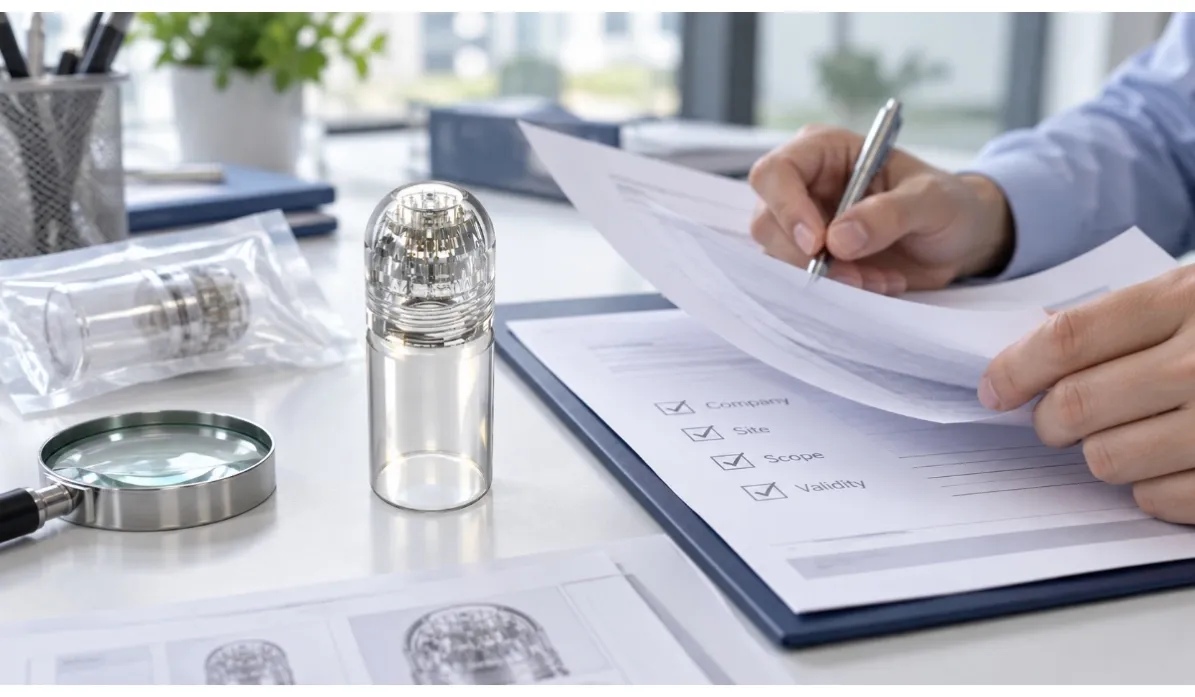
Is the certificate current?
Review:
- Standard version
- Certificate number
- Issue date
- Expiry date
- Certification body
- Certified company name
- Site address
- Scope of certification
ISO states that ISO 13485:2016 was reviewed and confirmed in 2025 and remains the current edition.
ISO itself does not issue company certificates. Certification is performed by independent certification bodies, so buyers should verify the issuer and certificate status rather than relying only on an ISO logo.
What ISO 13485 Does Not Prove
An ISO 13485 certificate should not be presented as evidence of claims it does not support.
By itself, it does not prove that:
- A specific microneedling model has passed every required test
- The supplied needle material matches a test report
- A product is sterile
- Every shipment has passed release inspection
- A device has FDA clearance or approval
- A product carries valid CE documentation
- A product has been registered in the buyer’s country
- A private label version can automatically use another brand’s regulatory file
- The buyer’s planned marketing claims are permitted
These questions require product-specific or market-specific evidence.
For example, biological evaluation reports, sterilization records, packaging information, product specifications and instructions for use each answer different questions. They should not be replaced by a factory’s ISO certificate.
ISO 13485 and the U.S. FDA QMSR
This subject became especially relevant to U.S. buyers in 2026.
On February 2, 2026, the FDA’s Quality Management System Regulation became effective. The revised 21 CFR Part 820 incorporates ISO 13485:2016 by reference while retaining additional FDA definitions and requirements.
The alignment makes ISO 13485 highly relevant to medical-device quality systems in the United States.
However, an ISO 13485 certificate should still not be described as FDA clearance or proof that a specific product is authorized for sale.
The FDA continues to apply its own regulatory requirements and inspection authority. Its QMSR guidance also explains that the U.S. regulation includes provisions intended to remain consistent with other applicable FDA requirements.
A buyer should therefore separate two questions:
- Does the manufacturer operate an applicable quality management system?
- What U.S. regulatory pathway and requirements apply to this exact product?
The ISO certificate helps evaluate the first question. It does not answer the second one by itself.
ISO 13485 Is Not the Same as ISO 10993 Testing
Buyers sometimes receive an ISO 13485 certificate together with reports referring to ISO 10993 and assume the documents provide the same type of evidence.
They do not.
ISO 13485 relates to the organization’s quality management system.
ISO 10993 reports may evaluate biological endpoints for specific test articles, such as:
- Cytotoxicity
- Skin sensitization
- Irritation
The test report must be reviewed to determine which material or product was actually tested.
A biological test performed on a 24K gold-plated needle and stainless-steel component should not automatically be described as a test of every device body, reservoir, adhesive, packaging material or serum formula.
This distinction will be covered separately in the next compliance article.
A Better Document-Review Process
Instead of asking only, “Do you have ISO 13485?”, buyers can ask:
Please provide the current ISO 13485 certificate and confirm which company, manufacturing site, product category and activities are included in its scope.
After checking the certificate, move to the exact product:
- What is the confirmed device model?
- Which company manufactures it?
- Which materials contact the user or serum?
- Which reports apply to those materials?
- What is sterilized?
- How is the sterile product packaged?
- Which batch documents are available?
- Does the IFU match the supplied configuration?
- What additional documents are required in the destination market?
This turns a certificate request into an actual product review.
How BegoSkin Handles Compliance Requests
For a private label micro-infusion project, we first confirm:
- Exact device model and configuration
- Intended use
- Target sales market
- Branding and packaging requirements
- Documents required by the buyer or regulatory consultant
We can then organize the available manufacturing certificates, specifications, test reports, sterilization documents, packaging information and instructions for review.
If the project requires additional market-specific testing or registration work, that requirement should be identified separately before production.
We do not treat an ISO 13485 certificate as a substitute for FDA authorization, CE documentation or product-specific test evidence.
Review the Product, Not Only the Certificate
ISO 13485 is an important supplier-assessment document, but it is one part of a larger compliance review.
A professional buyer should verify the certificate and then connect it to the actual manufacturer, production site, product configuration and supporting technical documents.
If you are evaluating a private label microneedling or micro-infusion project, send us your selected model, intended use, target market and required-document list.
We will help you distinguish between documents already available for the product and additional work that may be required for your project.