Sep 10, 2026Microneedling OEM & Private Label
Is the Needle Head or the Complete Microneedling Product EO Sterilized?
A buyer asked whether only the needle head or the complete microneedling product was EO sterilized. Here is how suppliers should answer clearly.
A U.S. customer recently asked us a short but important question:
“Is only the needle head sterilized, or is the complete product sterilized?”
The question came during the customer’s technical review of our microneedling sample.
It reminded us that saying a product is “EO sterilized” is not specific enough. A buyer still needs to know exactly what goes through the sterilization process.
The Sterilized Unit Must Be Identified
Different microneedling products can have different configurations.
In one configuration, only the detachable needle head may be individually packed and sterilized. The device body is reusable and is not part of that sterile package.
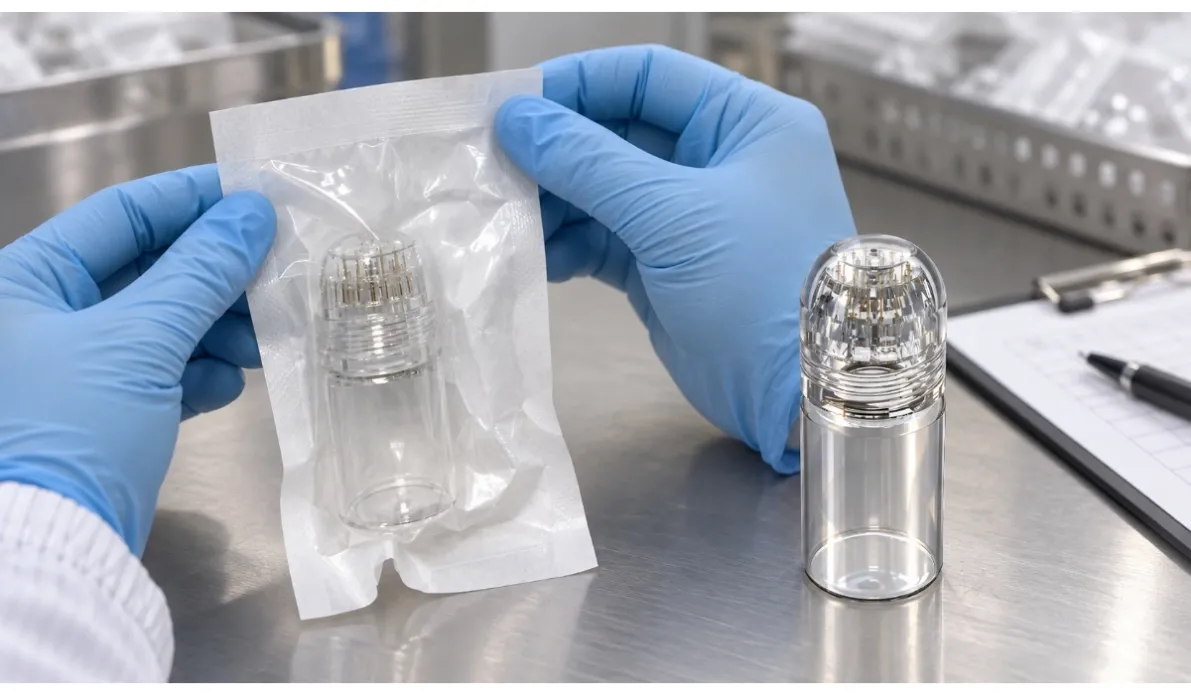
In another configuration, the complete disposable product may be treated as one sterilized unit and supplied inside a sterile barrier pouch.
These two configurations should not be described in the same way.
The supplier should clearly state:
- Which component is sterilized
- Whether the product is disposable or reusable
- Which parts are inside the sterile packaging
- Whether the sterilization record matches the supplied model
Without these details, the phrase “EO sterilized” can easily cause a misunderstanding.
Our Answer for This Customer’s Sample
For the specific product configuration discussed with this customer, the complete product—not only a loose needle head—is treated as the sterilized unit.
The finished product is supplied sealed inside a sterile barrier pouch.
This means the sterilization description needs to refer to the complete packaged product configuration reviewed by the customer.
It should not be supported by a generic sterilization document belonging to a different needle head, package or model.
Why the Sterile Barrier Pouch Matters
Sterilization and packaging cannot be reviewed separately.
The pouch provides a barrier between the processed product and the external environment. If it is damaged, opened or poorly sealed, the original sterile condition cannot simply be assumed.
Before approving a sample, buyers should check whether:
- The pouch is completely sealed
- The seal area is even and undamaged
- The packaging has no punctures or tears
- The product information can be connected to the correct model or batch
- The instructions explain how the packaged product should be handled
A normal plastic bag and a sterile barrier pouch are not the same type of packaging.
The Document Must Match the Actual Product
A sterilization report is useful only when the buyer can connect it to the product being purchased.
The product name, model, packaging configuration and sterilized unit should be consistent across the available documents.
If the report covers only a needle component, it should not be used to claim that the entire product was sterilized.
If the complete packaged product is the sterilized unit, the supplier should describe it that way consistently in the specification, quotation and instructions.
This was the real purpose of the customer’s question. They were not simply asking whether EO sterilization had been performed. They wanted to know what the statement actually covered.
One Clear Question Can Prevent a Larger Problem
This inquiry is still undergoing technical review, so it is not a completed-order story.
However, the customer asked the right question before moving forward.
When sourcing an EO-sterilized microneedling product, do not stop at:
“Is it sterilized?”
Ask instead:
“Exactly which product or component is sterilized, and how is it packaged afterward?”
That question gives the supplier something specific to confirm and helps the buyer compare different products more accurately.
BegoSkin supplies several microneedling configurations with different device, needle-head and packaging structures.
Send us the exact model you are evaluating, and we will confirm the sterilization scope and packaging configuration that apply to that product.