Microneedling OEM & Private Label
Why Test Microneedling Instructions Before Bulk Production?
A Hungarian buyer’s E24 sample test revealed questions about priming, filling, serum use and technique—showing why IFU validation matters before bulk orders.

A Hungarian healthcare-products buyer recently tested an E24 micro-infusion sample with our matching PDRN cosmetic serum.
The sample configuration included E24 applicators in 0.25 mm and 0.5 mm versions, together with 5 mL serum samples.
After completing her first facial evaluation, the buyer sent us detailed feedback.
She reported that very little serum was released at the beginning. The serum gradually started flowing, but the complete facial process took approximately 30 minutes and a considerable amount remained in the reservoir.
She also noticed that she had filled the reservoir almost completely, leaving very little air space.
Instead of simply concluding that the product did not work, she asked several practical questions:
- How quickly should the applicator be pressed?
- Does it need to be primed before facial use?
- Is there a recommended maximum filling level?
- How much serum is normally required?
- Can any remaining serum be kept for another treatment?
- Is the needle head strictly single-use?
- Can the supplier provide a video showing the correct technique?
This feedback revealed an important point:
A product sample does not only test the device. It also tests whether the instructions are clear enough for the future customer.
This Was Sample Feedback, Not a Product Complaint
The buyer was evaluating samples before deciding whether the product was suitable for her business.
No bulk order had been delivered, and this was not an end-customer complaint.
The feedback should therefore be treated as product-development information. It helps identify which parts of the instructions, demonstration materials and final kit configuration still need clarification.
Immediately describing the experience as a defective-product issue would be premature.
The slow initial dispensing could have been influenced by several factors:
- The selected applicator structure
- The serum viscosity
- The quantity placed in the reservoir
- Air remaining inside the flow channel
- Whether the applicator had been primed
- Pressing rhythm and device position
- The user’s expectation of treatment speed
These factors should be reviewed together using the actual device-and-serum combination.
Our microneedling sample quality checklist explains the broader points buyers can record during sample evaluation. In this project, however, the feedback highlighted one specific issue: the operating instructions themselves also needed to be tested.
1. The Instructions Must Explain the Priming Process
A first-time user should not have to guess whether the applicator needs several initial presses before the serum reaches the dispensing area.
The instructions should clearly explain:
- How to remove the individually packaged needle head
- How much serum to pour into the reservoir
- How to attach and tighten the needle head
- How to turn the applicator upside down
- Where to perform the initial presses
- How to confirm that air has been expelled
- How to recognize normal serum flow before facial use
E24 Assembly and Priming Guide
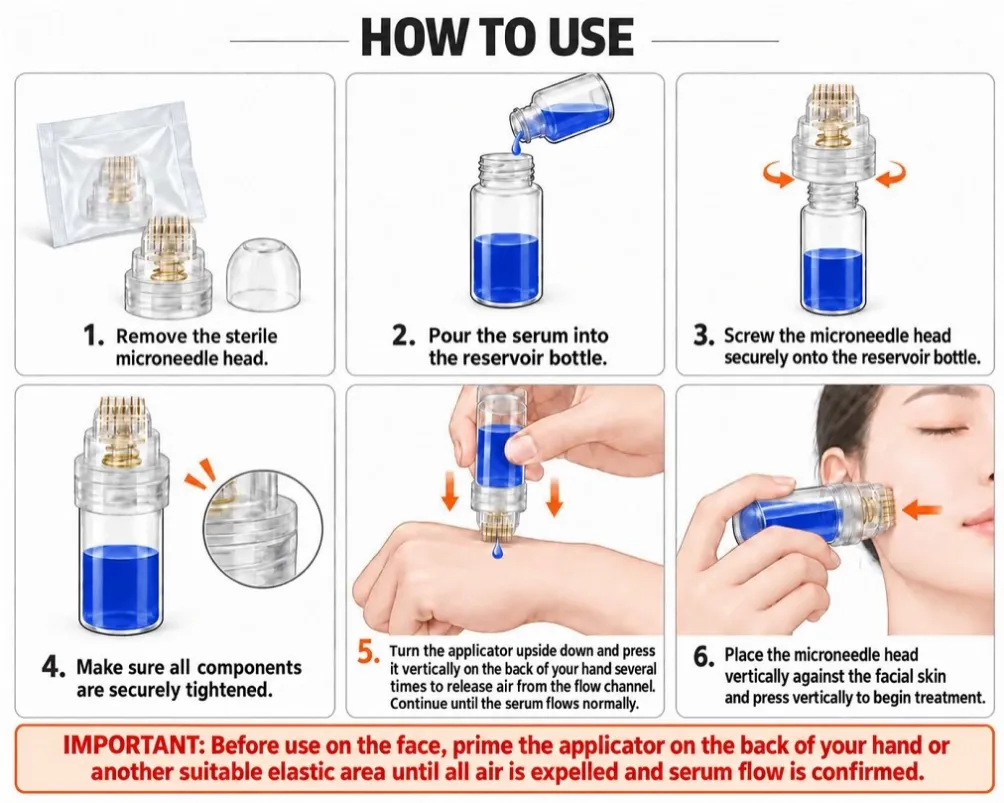
Figure 1. Example E24 assembly and priming sequence. Before facial use, turn the applicator upside down and press it vertically on the back of the hand until the air is expelled and normal serum flow is confirmed.
The visual guide was prepared to make the operating sequence clearer after reviewing the questions raised during the Hungarian buyer’s sample test.
It provides more practical information than a short instruction such as “press repeatedly.”
The final instructions for use should still match the exact device model, serum formula and approved product configuration supplied to the buyer.
2. The Filling Level Should Be Verified
The buyer reasonably asked whether filling the reservoir almost completely could have affected dispensing.
This should not be answered by assumption.
The appropriate process is to repeat the evaluation using the same:
- E24 sample
- Serum formula
- Filling quantity
- Assembly method
- Priming method
- Pressing technique
Different filling levels can then be compared to determine whether the amount of air space materially affects the initial flow.
If a maximum filling level is required, it should be stated in the instructions and, where practical, shown visually.
It should not remain an informal recommendation provided only after the user encounters difficulty.
3. “Press Repeatedly” Is Not a Complete Instruction
Different users may interpret the same wording very differently.
“Press repeatedly” could mean:
- Fast tapping movements
- Slow individual presses
- Holding the device in one position
- Moving immediately after each press
- Increasing pressure when serum is not visible
These techniques may create different dispensing and application experiences.
A useful demonstration should show:
- The correct device position
- An approximate pressing rhythm
- How to move between facial areas
- What normal serum release looks like
- When the user should stop and check the applicator
The purpose is not to promise exactly the same treatment time for every person. It is to give buyers and future consumers a repeatable starting method.
4. Serum Quantity and Single-Use Parts Must Be Explained Separately
The Hungarian buyer also asked whether the remaining serum could be used later and whether the needle head was strictly single-use.
These are two separate questions.
The supplied needle heads are individually packaged and intended for single use. The instructions should clearly distinguish the disposable needle head from any reusable applicator components.
The serum question depends on the final formula, container, opening method, storage conditions and approved usage directions.
A 5 mL vial should not automatically be described as one complete facial treatment simply because of its nominal volume.
In this case, the amount of serum remaining after the evaluation indicated that the recommended filling quantity and expected consumption still needed to be clarified before the brand prepared its retail instructions.
How We Responded to the Feedback
We did not dismiss the experience as user error, and we did not immediately classify the sample as defective.
Our review process included:
- Recording the buyer’s complete testing procedure.
- Retesting the E24 with the same matching serum.
- Reviewing the assembly and initial priming process.
- Checking the filling quantity and applicator position.
- Preparing clearer visual operating instructions.
- Evaluating whether another device structure might better match the buyer’s expected user experience.
ER24 and ER50 use a different pump-based structure. They may be evaluated if the buyer prioritizes a more controlled dispensing experience.
However, changing the device should follow a proper comparison test. It should not be presented as the solution before the original E24 sample and operating method have been reviewed.
Buyers comparing standard and pump structures can also read Why Photos Cannot Confirm a Pump Micro-Infusion Device.
At the time of writing, the evaluation is still in progress. We are not presenting the E24 as rejected, approved or formally replaced.
What Should Be Confirmed Before Printing the IFU?
Before approving private label packaging and instructions, buyers should confirm:
- The exact device and serum combination
- Assembly steps
- Priming procedure
- Recommended filling quantity
- Device position and pressing technique
- Expected serum-consumption range
- Single-use components
- Handling of opened serum
- Cleaning or storage of reusable components
- Applicable cautions and limitations
- Whether the demonstration guide matches the supplied model
These points should be verified using the final sample configuration—not copied from a visually similar product.
Sample Testing Should Improve the Retail Instructions
The Hungarian buyer’s feedback did more than describe the initial serum flow.
It showed where a future customer might hesitate, misunderstand the product or use it differently from the method expected by the supplier.
That is why operating instructions should be tested before printing hundreds or thousands of private label leaflets.
For a private label micro-infusion project, BegoSkin can help coordinate the device, matching cosmetic serum, sample evaluation, demonstration materials and packaging instructions.
When providing sample feedback, describe what happened, when it happened and how the applicator was prepared. This gives the supplier more useful information than simply saying the product “worked” or “did not work.”