Microneedling OEM & Private Label
Does Your Beauty Brand Need Three Different Serums for Hydration, Firming and Brightening?
Does your beauty brand need three serums for hydration, firming and brightening? Learn when one multi-benefit formula can simplify OEM development and SKU planning.
When developing a private label skincare collection, many beauty brands begin by identifying the benefits they want to offer.
Three common objectives are:
- Hydration
- Improved appearance of skin firmness
- Brighter-looking skin
A common assumption is that each benefit requires a separate serum.
But is it necessary to develop three different formulas?
Not always. One carefully developed cosmetic serum may be designed to address multiple skincare concerns.
For brands planning a new micro-infusion product collection, understanding this distinction can help simplify formulation development, reduce unnecessary SKUs, and improve inventory planning.
1. A Real Buyer Question: Do We Need Three Different Formulas?
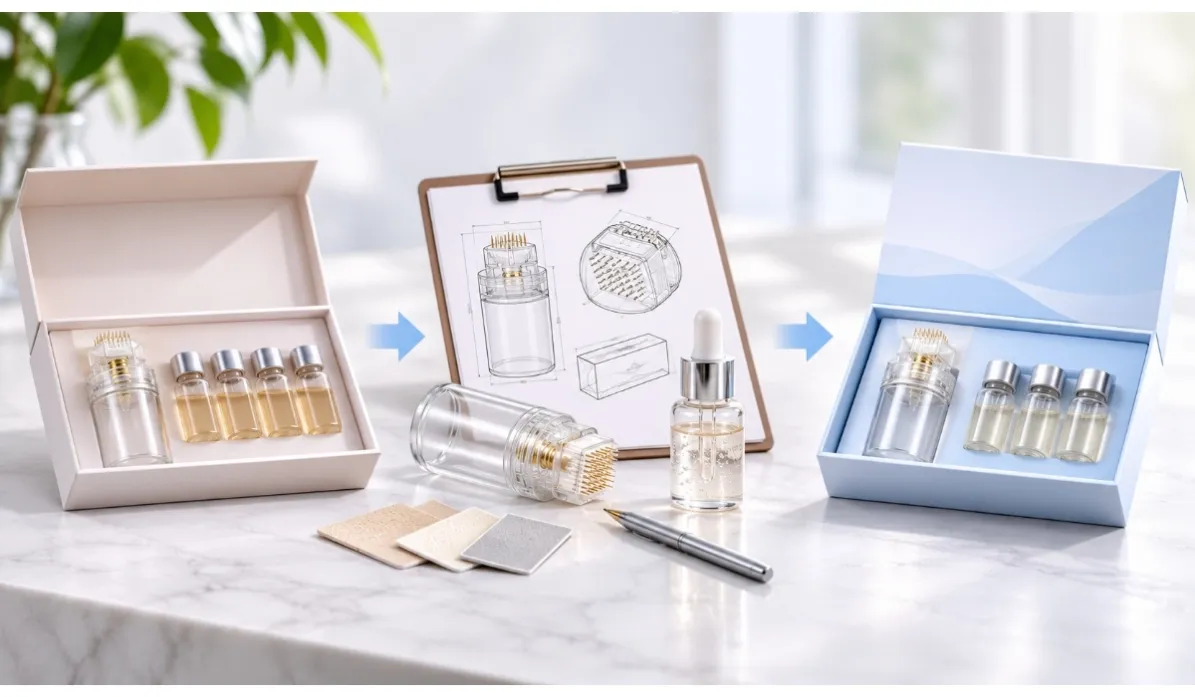
Recently, a European skincare brand contacted BEGOSKIN about developing a private label micro-infusion kit.
The customer was considering three skincare objectives:
A — Hydration
B — Firming
C — Brightening
Initially, these were discussed as separate product directions.
However, after reviewing the requirements, we explained that the brand might not need three completely different cosmetic serum formulations.
An existing multi-benefit formulation could potentially provide a starting point for all three objectives.
The next step was to evaluate whether the proposed ingredient combination and product positioning could support the customer's expectations.
This illustrates an important point:
The number of skincare benefits does not necessarily determine the number of formulas a brand needs.
2. How Can One Serum Support Multiple Skincare Benefits?
Modern cosmetic formulations often combine ingredients with complementary functions.
For example, a serum may contain ingredients selected for different cosmetic objectives.
Hydration
Ingredients such as glycerin, sodium hyaluronate, and panthenol are commonly used to support skin hydration and conditioning.
Firming Appearance
Certain cosmetic peptides and moisturizing ingredients may help improve the appearance of skin smoothness and firmness, depending on the finished formulation and supporting evidence.
Brightening Appearance
Ingredients such as niacinamide may be included in formulations designed to improve the appearance of uneven skin tone.
These ingredients do not necessarily require separate products.
A laboratory may evaluate whether they can be combined into one balanced formula.
However, combining ingredients does not automatically guarantee that the finished product will deliver every claimed benefit.
Formulation stability, ingredient concentrations, skin compatibility, and efficacy evidence must still be considered.
3. When Does One Multi-Benefit Serum Make Sense?
A multi-benefit serum may be a practical option when a brand is preparing its first product launch.
For example, consider a brand planning to introduce three different cosmetic serums.
Each formula may require its own:
- Development and sampling process
- Stability assessment
- Packaging compatibility evaluation
- Product documentation
- Production quantity
- Inventory management
If the brand instead launches one carefully positioned multi-benefit serum, some of these activities may be consolidated.
This can simplify the initial project.
For brands testing a new market, a focused product collection may also make it easier to understand customer feedback before expanding the range.
The goal is not simply to reduce the number of products. It is to avoid unnecessary complexity during the first launch.
4. When Should a Brand Develop Separate Serums?
Although a multi-benefit serum can be useful, separate formulations may be appropriate in certain situations.
Different Target Customers
A brand may serve customer groups with significantly different skincare needs.
For example, a lightweight hydrating serum and a richer conditioning serum may require different formulation approaches.
Different Product Textures
A brand may want one fast-absorbing serum and another product with a more substantial skin feel.
These differences can justify separate formulations.
Different Hero Ingredients
Some brands build individual products around specific hero ingredients.
Separate formulas may help communicate a clearer product concept.
Different Intended Uses
Products intended for ordinary topical skincare and products intended for use on compromised skin have different safety considerations.
A standard cosmetic serum should not be assumed suitable for application through microneedling-created channels.
When the intended use changes, additional product development and regulatory evaluation may be required.
5. Does One Formula Automatically Mean Lower Manufacturing Costs?
Not necessarily.
A multi-benefit serum may simplify product development and inventory management, but its unit cost depends on the formulation.
For example, a formula containing several specialized peptides or other expensive ingredients may cost more than a basic hydrating serum.
Manufacturing costs may also depend on:
- Raw material selection
- Ingredient concentrations
- Packaging specifications
- Production volume
- Testing requirements
- Customization complexity
Therefore, brands should compare the total project cost rather than assuming one formula will always be cheaper.
For new brands, the more important consideration may be reducing the number of separate products that must be developed, tested, and managed.
6. How Should Brands Decide Between One Serum and Three?
Before requesting three separate formulations, we recommend answering three questions.
First: Are the target customers the same?
If all three benefits are intended for the same customer group, a multi-benefit formula may be worth evaluating.
Second: Does each product need a different texture or ingredient identity?
If the brand requires significantly different formulations, separate products may make more sense.
Third: Is the brand launching a new collection or expanding an established product line?
A new brand may benefit from starting with one focused formula.
An established brand with different customer segments may have stronger reasons to develop multiple products.
The decision should reflect the brand's product strategy rather than simply the number of desired skincare benefits.
7. A Practical OEM Development Approach
For brands considering hydration, firming, and brightening benefits, a practical starting point is to discuss one multi-benefit cosmetic formulation with the laboratory.
The development process may include:
- Confirming the target customer and desired cosmetic benefits.
- Reviewing suitable existing formulations.
- Evaluating ingredient compatibility and concentrations.
- Preparing samples for assessment.
- Conducting appropriate stability and safety evaluations.
- Confirming packaging and commercial production requirements.
If the brand later identifies demand for more specialized products, additional formulas can be developed.
This allows product expansion to follow a clearer commercial strategy.
For brands considering changes to active ingredients, our related article explains how concentration adjustments affect custom serum development.
Conclusion: More Benefits Do Not Always Require More Products
Hydration, firming, and brightening are three different cosmetic objectives, but they do not always require three separate serum formulations.
For some beauty brands, one well-developed multi-benefit serum may provide a more practical starting point.
The right decision depends on the target customer, product positioning, formulation requirements, and available budget.
Before developing multiple SKUs, brands should evaluate whether a single formulation can support their intended cosmetic benefits.
Planning a Private Label Serum Collection?
BEGOSKIN works with formulation partners to support custom cosmetic serum development for beauty brands.
We can help evaluate existing formulations and discuss customization options based on your product concept.
Are you planning one multi-benefit serum or several separate formulas for your brand?