Aug 31, 2026Microneedling OEM & Private Label
Can 1,000 Microneedling Kits Be Split into Face and Scalp Versions?
Learn whether a 1,000-piece private label microneedling kit MOQ can be divided between face and scalp versions, packaging and serum options.
A UK beauty brand recently contacted us while developing an at-home microneedling kit.
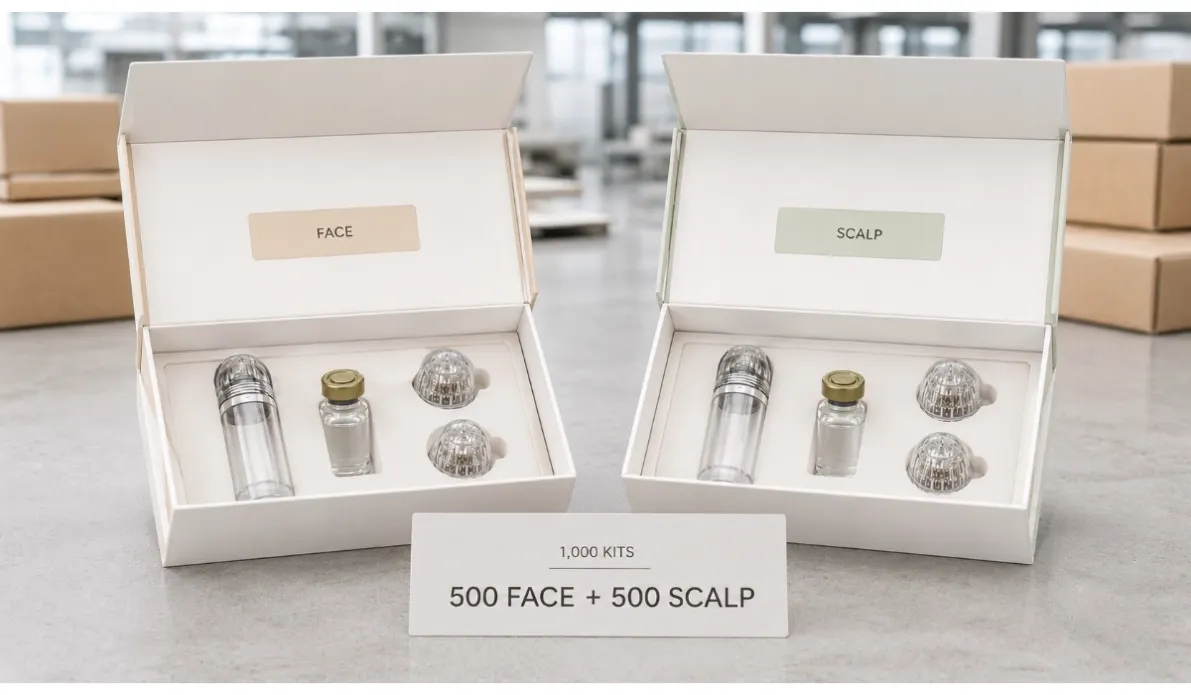
The original concept included both face and scalp applications. Instead of ordering 1,000 identical kits, the buyer wanted to know whether the MOQ could be divided between two versions.
For example:
- 500 face microneedling kits
- 500 scalp microneedling kits
This sounds like a simple quantity split, but from a manufacturing perspective, it may involve different needle heads, serums, packaging artwork, instructions and inner trays.
So, can one microneedling kit MOQ be divided between face and scalp versions?
The answer is:
It may be possible, but the supplier must review the MOQ of every customized component—not only the total number of finished kits.
The Client’s Product Idea
The client was looking for a home-use needle stamp kit inspired by an existing premium treatment concept.
The proposed product range included:
- A face version
- A scalp version
- Microneedling devices
- Compatible serum products
- Customized packaging
- The client’s own branding
The buyer wanted both versions to be included within an initial order of approximately 1,000 kits.
This approach could help the brand introduce two applications without purchasing 1,000 finished units of each version. However, it also created additional production questions.
One Finished-Kit MOQ Can Include Several Component MOQs
A private label microneedling kit is not manufactured as one single component.
It may contain:
- Device body
- Needle head
- Serum bottle or ampoule
- Inner tray
- Retail box
- Instruction leaflet
- Product label
- Protective outer packaging
Each component may have a different production minimum.
For example, the device supplier may accept a combined quantity if both versions use the same device body. But the printed box manufacturer may require a separate MOQ for each artwork.
This is why buyers should not only ask:
Can you make 500 face kits and 500 scalp kits?
They should also ask:
Which components can be shared, and which components require separate production quantities?
When Is a 500 + 500 Split Easier?
A mixed configuration is generally easier to arrange when the two versions share most components.
For example:
Component | Face Version | Scalp Version |
|---|---|---|
Device body | Same | Same |
Device color | Same | Same |
Needle head | Different or selected specification | Different or selected specification |
Serum | Face serum | Scalp serum |
Inner tray | Same structure | Same structure |
Outer box | Shared design or separate artwork | Shared design or separate artwork |
Instructions | Different application section | Different application section |
If the device body, box structure and inner tray remain the same, the factory may only need to separate the needle heads, serum and identification method.
If every component is different, the project effectively becomes two separate products, even if the combined order reaches 1,000 pieces.
Packaging Is Often the Main MOQ Challenge
Customized packaging is frequently more difficult to split than the device itself.
If the face and scalp kits use two completely different printed boxes, each design may need to meet the packaging supplier’s minimum production quantity.
This could result in:
- 1,000 face boxes
- 1,000 scalp boxes
Even if only 500 finished kits of each version are assembled for the first shipment.
One possible arrangement is to produce the required packaging quantity and keep the unused boxes for a future repeat order. Storage period, remaining quantity and material condition should be recorded clearly.
This is similar to a project we completed for another European beauty-device customer: 500 finished branded kits were shipped first, while the additional printed packaging was reserved for the repeat order.
However, this arrangement depends on the packaging structure and factory conditions. It should not be assumed to apply to every project.
Three Ways to Reduce the Packaging MOQ Risk
1. Use One Shared Outer Box
The brand can create one main package design covering the complete microneedling range.
Face and scalp versions can then be identified using:
- A color label
- A product sticker
- A barcode label
- A checked variant area
- A separate instruction card
This reduces the need to print two entirely different boxes.
The design must still make the product version clear to distributors and end customers.
2. Keep the Same Box Structure
If separate artwork is necessary, keeping the same box dimensions and inner-tray structure can simplify production.
Only the printed artwork and kit contents change.
This avoids developing two box structures and two sets of inserts at the same time.
3. Separate Product MOQ from Packaging MOQ
The quotation should clearly show:
- Quantity of finished face kits
- Quantity of finished scalp kits
- Printed packaging quantity for each version
- Unused packaging quantity
- Storage arrangement
- Future assembly cost
- Validity of remaining serum or packaging materials
This prevents the buyer from confusing the number of finished products with the number of printed boxes produced.
Should the Face and Scalp Kits Use Different Serums?
If serum ampoules are included, the formulas should match the intended product positioning.
A face and scalp version should not be created by changing only the words on the box while using unclear or unsupported product instructions.
Before confirming the serum configuration, buyers should review:
- Intended cosmetic use
- Formula viscosity
- Device compatibility
- Ampoule volume
- Ingredient documentation
- Label information
- Target-market requirements
- Shelf life and storage
If two formulas are used, each formula may also have its own development, filling and packaging MOQ.
The serum quantity should therefore be included in the mixed-MOQ calculation from the beginning.
Instructions Must Clearly Separate the Two Versions
A mixed product range can create customer confusion if the packaging looks too similar.
The final kit should make it easy to identify:
- Which product is for the face
- Which product is for the scalp
- Which needle head is included
- Which serum belongs to each kit
- Whether replacement heads are interchangeable
- How the components should be stored and handled
A shared instruction booklet may be possible, but the face and scalp sections should be clearly separated.
What Should Buyers Confirm Before Requesting a Mixed MOQ?
Before asking for 500 face kits and 500 scalp kits, prepare the following information:
- Device model for each version
- Needle specification for each version
- Serum requirement
- Number of replacement heads
- Shared or separate box design
- Shared or separate inner tray
- Instruction format
- Quantity required for the first shipment
- Packaging that may be kept for repeat orders
- Target sales market
The supplier can then calculate which components may be combined and which require separate minimum quantities.
The Key Lesson from This Inquiry
The client’s question was not simply about whether 1,000 units could be divided into two groups.
The real question was how to create two clear retail products while sharing enough components to control the first-order inventory.
A mixed MOQ is most practical when the face and scalp versions share the same core device and packaging structure.
The more differences a buyer adds, the more likely the project will be treated as two separate custom products.
Planning Face and Scalp Microneedling Kits?
BegoSkin supports private label face and scalp microneedling kits, replacement needle heads, serum ampoules and customized packaging.
Send us your intended quantity and the differences between the two versions. We can help identify which components may share an MOQ and which need to be calculated separately.